
The Nuthatch
Don’t discount the common birds; sometimes they have a powerful message.

Dear Readers and Subscribers,
It has been a while since I’ve published anything. This is partly due to being in a sustained period of dissolution and void as we navigate a potential big move, and partly due to being a parent.
I’ve had to admit to myself that I cannot be the writer I was when my schedule was solely dedicated to myself. Nor do I have the bandwidth of time to spend that I used to, carefully editing, rephrasing, and getting my writing just so.
If I wait to have the time I desire to dedicate to writing, I simply will not write.
If I want to continue to share my thoughts, reflections, and observations, I have to change my expectations of what my writing looks like.
Also, I don’t want to depend on AI to proofread my essays; I have done so a couple times in the past. It’s easy and quick (anything that saves time for a busy mom is tempting), but even though I ask it not to change my words, I can’t help but feel that something is missing when I’m not doing the “clean up work” myself.
Besides that, I have a lot of ethical issues with AI, not the least of which is its environmental toll. As the Colorado and Dolores rivers dry up and water is rationed, I look to the city-sized data center being built next door in Utah (among others) that will require enormous amounts of water. Sometimes it feels as though the small percentage of humanity that sits in the wealth tier of “billionaire” are intentionally speeding up the collective demise.
Humans cannot live without the Earth. We do not survive without the ability to grow food.
And instead of using their tremendous resources to protect this planet— this spinning jewel in cold, dark space that literally grows medicine, feeds us, and provides our water— they look to colonize the dead rock next door. A rock devoid of all things essential for human survival (and also: no birds. Can you imagine living on a planet devoid of bird song? Seeing nothing flying overhead, ever?).
But I digress.
All this to say — I want to write more frequently, but I don’t have the time to put out exactly the quality I want to. And, I don’t want to compensate by using the “easy button” that AI offers.
Therefor… you may find redundancies, grammatical errors, and typos. Phrasing may at times feel clunky or unpolished.
Thank you in advance for sticking with me despite the imperfections.
Now, onto The Nuthatch.
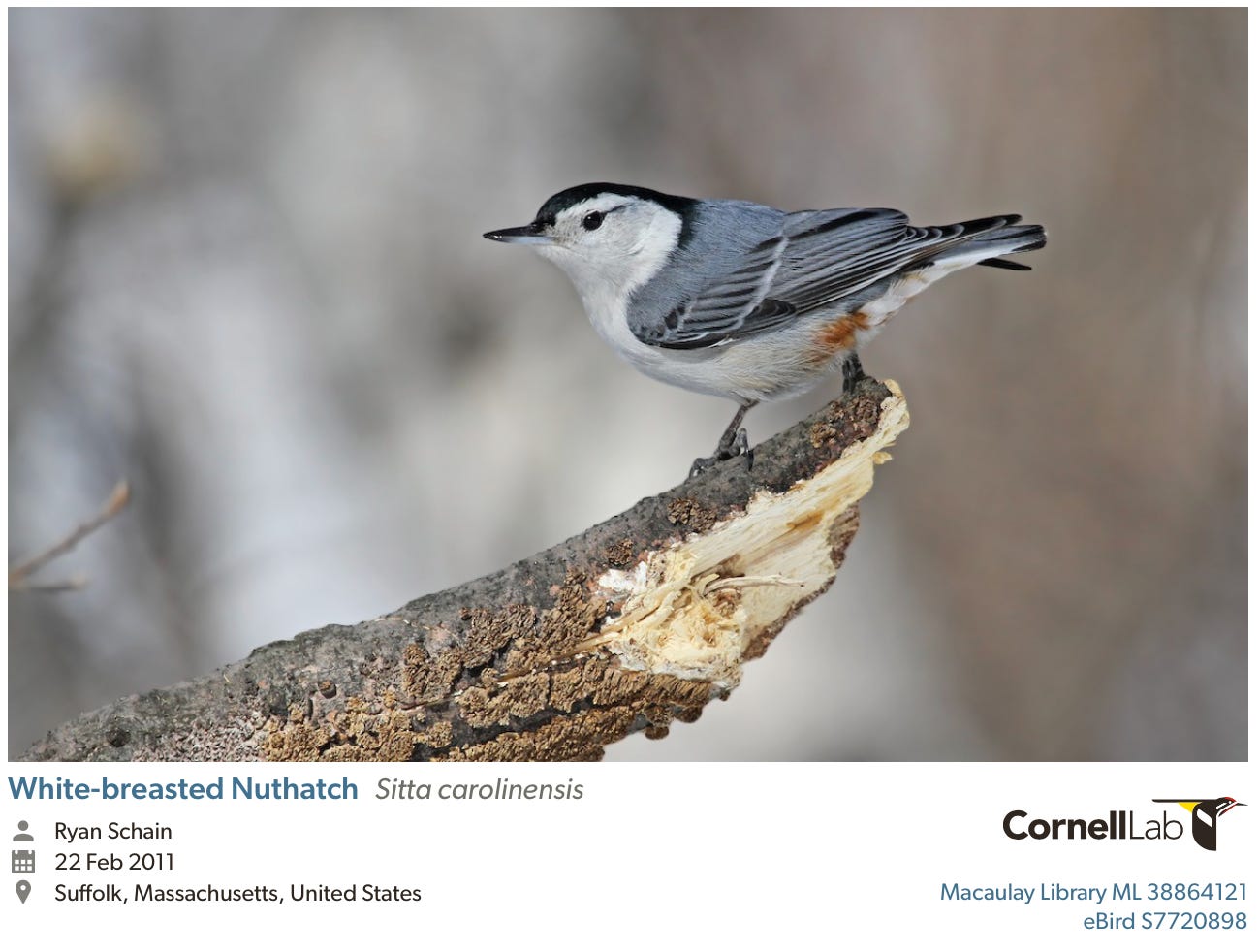
I walked into our mudroom just in time to see a bird, having flown inside and unable to find its way back out, hit the window with a loud thud.
Rushing over, I found a small, bluish-gray, black, and white bird, with a beak not unlike a woodpecker’s, stunned on the floor.
Not wanting it to regain its composure in an enclosed area and attempt to fly through the window again, I scooped it up and took it outside to the closest tree, a heritage plum.
I offered it a branch, but it did not move. It remained in my hand, breathing heavily, panting through a parted beak.
Standing as still as possible, I watched its eyes open and close, as its small white chest pulsated with quick breaths.
Birds often recover after flying into windows, but after five minutes of standing there with it in my opened, cupped hand, I started to worry that it wouldn’t be okay.
I studied its delicate features, felt wet poop in my hand, and softly told him, “I won’t hurt you. You can go as soon as you’re ready.”
While he (or she) probably didn’t understand me, I think these things are important to say. Many animals seem to understand our intentions. And, as our voices carry unique vibrations, I believe that speaking in a soft, calm voice can help communicate a sense of safety.
My six year old son found me and asked to see the bird, so I gently brought it to his eye level.
“You’ll be okay, birdie,” he said in his little voice. “We’re gong to keep you safe.”
We waited together a few more minutes and then, suddenly, as if a light switch was flicked on, the stunned bird regained its alertness.
It blinked and flew out of my hand, brushing the side of my head with its wings before alighting on a branch of the plum tree.
From this more impersonal distance, it cocked its head and regarded me.
“I’m glad you’re okay,” I told it.
Then I walked back to the house with my son, creating more distance to show the bird that it was free and safe.
Once inside, I immediately consulted my bird book (just kidding; I whipped out my phone and consulted the great, wide web as one does) to figure out what kind of bird it was.
It didn’t take very long of looking at pictures of a “small gray, black, and white feathered bird with a longer, pointed beak native to Colorado” (exact search phrasing) to identify the bird I had the privilege of observing up close for nearly fifteen minutes.
Nuthatch: a common back yard bird. Like the woodpecker, it find insects in and on trees, and makes its nest in tree cavities.
One thing I’ve learned when learning from the birds is to never discount a common bird, or be disappointed that it is unexotic.
While the Romans used hawks, eagles, and vultures in their divination because they were rarer than songbirds and more visible from a distance, any bird can carry a message, and all birds have unique characteristics that can help us learn something about ourselves or a situation in our life.
In fact, I have this theory that the smaller, more common birds have particularly relevant and practical information for our day-to-day lives.
But maybe it’s just a bird.
True. And yet— I always pay attention when I have an unusual or special interaction with a bird, even if the bird itself is not unusual.
There’s no harm in taking note, and I find that when I do so, I will often receive confirmation later that it benefited me to pay attention.
In this case, I had some things leading up to this interaction with the Nuthatch, as well as confirmation afterward, which I’ll get into shortly.
In Ted Andrews’ book, Animal Speak, the Nuthatch reminds us to be grounded and to recognize that our material, everyday lives need to be integrated with the spiritual.
We are spiritual and physical beings, and as such we need to give an equal amount of attention to our physical body and environment as we do liminal spaces and psychic senses. You simply cannot have a spiritual life without the “life” part: the material, physical reality of existence on this planet at this moment in time.

The Nuthatch travels down trees headfirst. Ted Andrews says the lesson of the Nuthatch is to “have faith in your abilities and trust in what you have learned about applying spiritual rhythms and vibrations within the physical world.” (Animal Speak, pg. 169).
After I read this description, I immediately saw the relevance in my life.
And even if the “message” was not actually from the physical bird or some spiritual cosmic force, at the least it triggered my subconscious mind to identify a pattern / problem that I needed to address.
You see, about three weeks ago I realized I had lost most of my work documenting EFT (Emotional Freedom Technique) tapping sessions. I had taken Levels 1 and 2 from EFT International and for the past year had been working on logging 50 client sessions and writing up four cases studies.
The deadline to apply for my certification with EFT International with my practice hours and case studies was approaching June 15, and my work was simply gone.
Without getting into all the lengths I went to trying to track the work down, it seems the the file I had been working on randomly reverted back to a much earlier version (as in, it looked like I had last saved it in August 2025).
While frustrated, angry, and upset, I am unfortunately familiar with this pattern of acquiring knowledge and practice, and then never finishing things up in a neat and tidy way.
Usually, it’s my own damn fault, and this was not really an exception, although I’d love to Balme it squarely on technology.
I’m sure my procrastination around logging my session notes, which led to a marathon of transferring them to my digital file, and then led to — apparently— my work being completely swallowed by digital text gnomes.
Anyway, although I still felt a bit defeated and depressed, I had moved (reluctantly) into the acceptance phase.
And then Nuthatch shows up, reminding me to have faith in my abilities and trust in what I have already learned about “spiritual rhythms and vibrations” — right at the time I lost all my work for a literal rhythmic practice that heals and rewires the subconscious by releasing stuck emotions and thought patterns.
Nuthatch is also a companion of the woodpecker, further underscoring the idea of rhythm, and especially of finding new rhythms. In some Native American perspectives, the tap-tap-tapping of the woodpecker is said to be the heartbeat of the Earth (Ted Andrews, Animal Speak).
Now, no matter how clear the message, I always have a little whisper in the back of my head that says, “Maybe it was just a bird.”
Or, “Maybe it’s just coincidence.”
Maybe I’m trying to make things about me that are simply not about me.
The next day, I opened our front door to find the disembodied wings, still attached to a very small part of a torso, of a Nuthatch on our porch. Two feet from the entrance, laid out perfectly as if for display in a shadow box.
Instant sadness washed over me for the loss of life — especially after having just assisted one of these birds the day before— and I wondered if this was some grim irony.
But, as I looked up from the set of wings, I saw another Nuthatch merrily making its way down the trunk of our pine trees, upside down, pecking away.
They are, as I’ve said, common birds. I simply had not noticed their prevalence before.
The active Nuthatch answered the question that was sitting like a lump in my stomach: “Are these wings from the same bird I helped yesterday?”
The answer seemed to be: That’s not the right question. All life ends, new life begins, and life continues. We’re here. Pay attention.
I’m paying attention.
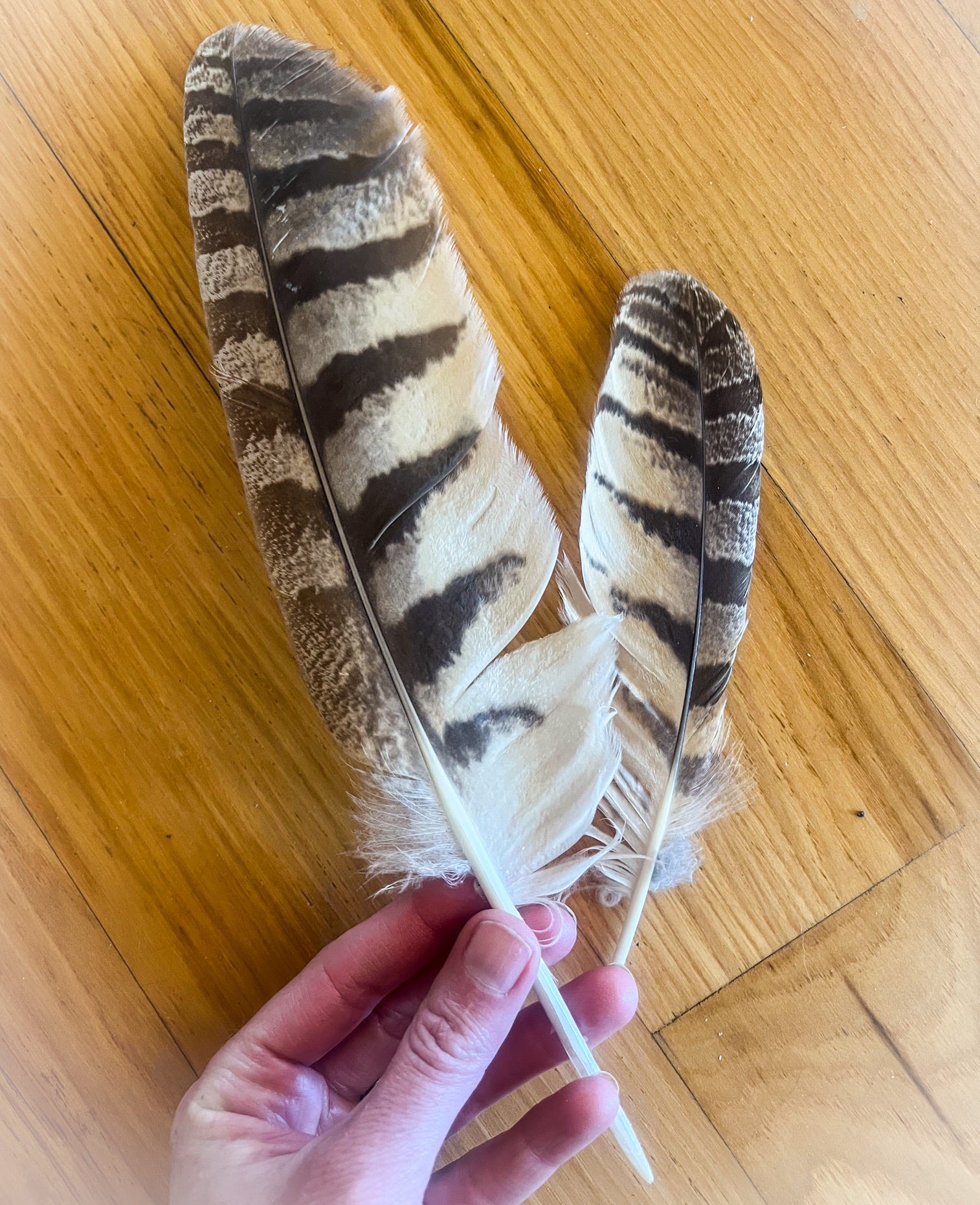
It was then I recalled that about a week ago I had found, over the course of a few days, two beautiful, hawk wing feathers. While we have resident red tail hawks here on our property (who I have a respectful relationship with), I’ve actually never found a hawk wing feather in the eight years we have lived here.
So let’s talk a minute about the hawk, because there’s a beautiful way in which it is related to the Nuthatch.
Hawks can bring their own messages, and are powerful guides and visionaries, but often they give you the heads-up that a message is coming. The message cold be from anywhere; they simply let you know one is on the way.
In this case, two flight feathers falling from the wings of a hawk in the sky to the ground were not only queuing me to pay attention, but also echoing the theme of the Nuthatch: bringing spiritual insight, rhythms, and energies (from “above”) to the material world (“below”).
The feather falls from the sky to the ground, literally grounding a thing from an aethereal space.
The feathers from the hawk prepared me to not discount the small, common Nuthatch and its practical message.
The small bird has lessons to ponder: not as a symbol, but as an invitation to synthesis.
It is inviting me to understand the characteristics of the Nuthatch and to feel what it’s like to have the rhythm of a Nuthatch in my life.
What is it like to have the confidence to go headfirst down the tree, gaining a new perspective and letting go of control?
Do I feel the lightness of being a small, agile bird?
Can I feel the rough tree bark under my feet as I turn myself upside down?
What do the vibrations of new rhythms feel like?
Can I sing a loud, simple song as the Nuthatch does, confidently and without complicating things?
What is it like to not overcomplicate anything, but to find a new rhythm while allowing things to unfold naturally?
Like tapping, birds — and indeed all flora and fauna — can offer us lessons and serve as a prompt to uncover some of our own subconscious beliefs, and acknowledge buried emotions.
As soon as we can uncover and release old patterns, we regain awareness as suddenly as the stunned Nuthatch in my hand did, and can see our life in a new way.
Only then, once that tired beat has stopped, are we free to hear a new drum and set a fresh, energizing rhythm.
If you like this, please take a second to hit that “like” button or leave a comment. It really helps!
Also: would you believe that as I was about to publish this yesterday, all the edits I was making in Substack disappeared? Despite the app “saving” my work every few seconds, the page refreshed and reverted back to my rough draft. I really don’t know what’s going on with this theme of my documents discarding the progress I’ve made, seemingly of their own accord. Send help, please and thank you.
Because you asked ("send help"), I cast a horary chart to explore your work disappearing. Alas, comments don't allow images, but, to summarize, the answer - as I read it - ends up as the Moon conjunct the Lunar South Node in the 12th house. This is a malefic configuration, effectively emptying the Moon of Her light in a place where your own self is undone and forced into seclusion. In one productive sense, a forced monastic review of what has ended, leading to the inception of the next cycle. This energy is not about a beginning, but the full experience of an ending or undoing. Now, that's not necessarily "help", as in the answer or solution to why your work keeps disappearing. Rather, I think, it resonates with your birdomancy re: the messages of the nuthatches. You already know that meaning as you wrote in your article. The stars seem to agree.
I love this, and just want you to know I've had a very overt visit from another "common" bird with a very, very strong message: the Kingbird. So much change and transition is underway, friend, and I think those of us with connections to the Titans are being asked to look out for ourselves-- and to embrace the poignancy of the quiet moments in our lives, especially if a small bird comes to visit!